
I redesigned how lenders create, reuse, evaluate, and monitor rules across complex commercial loans.
Role
Product Designer | Enterprise workflow and fintech
Duration & company
May 2022 to August 2022 | 4 months
My Squad
Product, Lending SMEs, Engineering, and QA
Context
One commercial loan could carry more than 150 rules that lenders had to create, evaluate, and track
Cync is a cloud-based loan origination platform used by commercial lenders to manage loans from application through servicing.
Covenants are rules borrowers must continue meeting after a loan is approved. They can cover financial thresholds, reporting obligations, insurance, collateral, and other conditions. A single loan could carry more than 150 covenants, each with its own frequency, deadline, calculation, and evaluation history.
The platform supported loan origination, but covenant creation and monitoring were fragmented. Lenders rebuilt common rules for every loan and relied on spreadsheets, notes, or memory to track what required attention.
Problem
The system treated covenants as records to enter, not an ongoing risk-management workflow
Creation was repetitive. Analysts re-entered the same definitions, formulas, relationship details, and loan information across similar deals.
Creation lacked context. Covenants started from a standalone tab instead of the loan they protected, increasing the risk of assigning a rule to the wrong relationship or loan.
Monitoring was invisible. The system did not clearly show upcoming deadlines, compliance, overdue evaluations, or historical performance. That operational workload lived in spreadsheets, Post-it notes, and people’s heads.
Baseline usability testing confirmed the friction. Participants took more than three minutes to assign one covenant, struggled to generate different covenant types, and could not interpret system terminology without help.


Research
Research showed that setup, evaluation, and monitoring were three different jobs forced into one unclear workflow
I interviewed three lending subject matter experts, surveyed 10 loan officers, reviewed competing loan platforms, and tested the existing workflow.
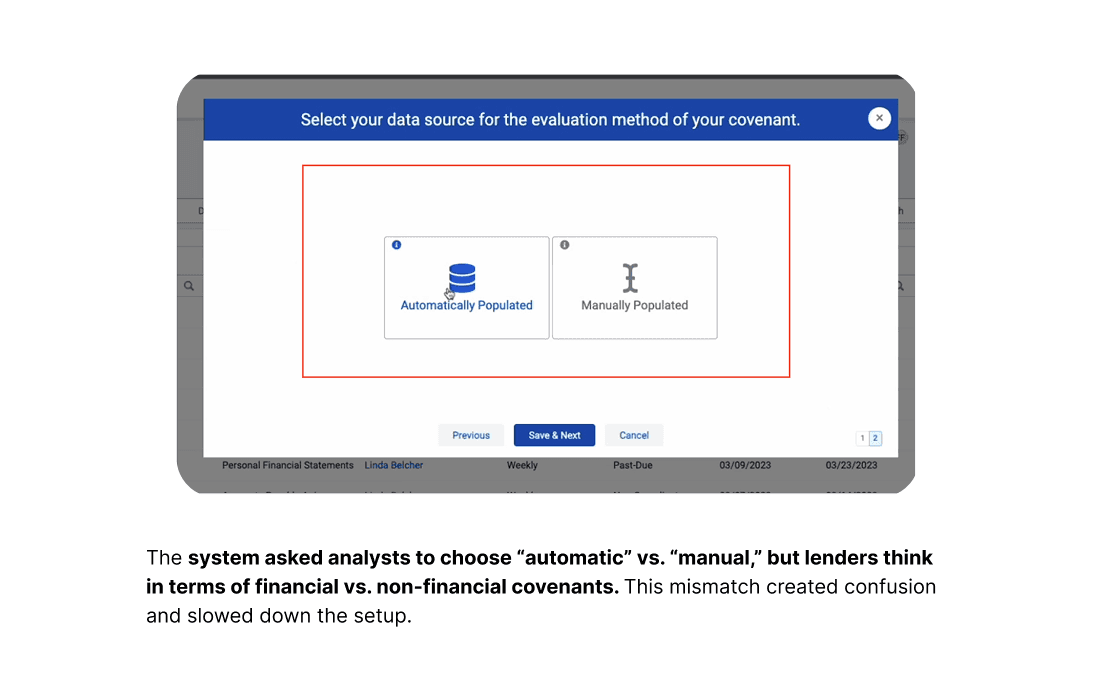
The research showed that lenders reused the same rule structures across loans, but adjusted thresholds and frequencies for each deal. They wanted automatic and manual covenants separated, needed reminders for upcoming evaluations, and found it confusing to assign an evaluation status while creating a covenant.
I mapped the lifecycle from administration to loan setup, evaluation, monitoring, and reporting. This reframed the project from improving one form into designing a connected covenant-management system.

Decisions and tradeoffs
Standardize covenant definitions before simplifying creation
Decision:
I designed a three-level library covering covenant types, subtypes, and reusable definitions with default descriptions, formulas, and frequencies.
Tradeoffs:
Administrators had to invest more effort upfront, but lenders no longer rebuilt common rules for every loan.
Constraints:
Existing production covenants could not be safely renamed or migrated, so the new structure had to coexist with legacy records.
Result:
Lenders could select an approved definition and adjust only the threshold, frequency, or terms unique to the deal.

Before
After
Create covenants inside the loan they protect
Decision:
I moved creation from a disconnected covenant tab into loan and relationship workflows, allowing the system to inherit the correct business context.
Tradeoffs:
This changed a familiar navigation pattern, but removed repetitive entry and reduced the risk of assigning a covenant to the wrong loan.
Constraints:
The flow had to preserve existing permissions, relationship structures, loan records, and legacy access from the covenant area.
Result:
Relationship, manager, and loan details populated automatically. Usability testing showed setup falling from 3 to 5 minutes to under 1 minute.

Before
After
Separate covenant setup from ongoing monitoring
Decision:
I treated assignment and monitoring as different jobs. Setup focused on defining the rule, while monitoring focused on deadlines, compliance, and evaluation history.
Tradeoffs:
The product gained more states and views, but each workflow became easier to understand and optimize.
Constraints:
The system architecture required ticklers to remain a separate flow instead of placing reminders directly inside evaluation history.
Result:
Lenders gained deadline reminders, a scannable compliance table, evaluation history, date filtering, and PDF or Excel export.
Before
After
Introduce lifecycle visibility without overbuilding V1
Decision:
I defined the minimum useful covenant states and added a lag period that reflected the time between a reporting deadline and an analyst completing the evaluation.
Tradeoffs:
More statuses created additional system logic and actions, but removed uncertainty about what was pending, active, overdue, waived, or unavailable.
Constraints:
The backend did not yet support a complete lifecycle model, so V1 had to prioritize the states lenders needed to make daily decisions.
Result:
Analysts could understand covenant health and required actions without maintaining a parallel tracking system.
Before
After
Align domain experts and engineering before details reached development
Decision:
I translated lending terminology into workflows, states, validation rules, and acceptance criteria, then reviewed the logic with subject matter experts, engineering, and QA throughout delivery.
Tradeoffs:
Frequent reviews required more coordination during design, but reduced ambiguity and expensive corrections during implementation.
Constraints:
Business rules differed by covenant type, while technical constraints limited which lifecycle relationships could ship in the first release.
Result:
The team reached shared decisions earlier, engineers received documented behavior and edge cases, and QA could validate the workflow against the intended lending logic.
Outcome
Setup time dropped below one minute
Reusable definitions and inherited loan context replaced repeated manual entry.
Lower risk of assigning rules to the wrong loan
Creation began inside the relationship or loan and inherited the correct context automatically.
Portfolio health became visible in one place
Compliance states, deadlines, history, filtering, and export replaced fragmented manual tracking.
Users no longer needed private workarounds
“This finally reflects how we actually work.”
“I don’t have to guess what this rule is trying to say anymore.”
“I took down my Post-it note.”
Behind the scenes
End-to-end ownership: I moved from domain discovery and competitive analysis into workflow strategy, information architecture, interaction design, usability testing, documentation, and implementation support.
Collaboration: I worked with three lending subject matter experts to validate terminology and business rules, reviewed design direction with a senior design mentor, and partnered with the Product Manager, three engineers, and QA to resolve feasibility, states, edge cases, and release scope.
Communication: I used workflow reviews and design critiques to align the team before development, documented interaction behavior and acceptance criteria for handoff, and stayed involved through implementation and QA.
What I learned: Complex enterprise products become easier when the system reflects the user’s mental model. The strongest design decision was not simplifying a form. It was separating reusable standards, deal-specific setup, and ongoing monitoring into the right layers.