I designed safe AI follow-ups that re-engaged silent leads and generated 131 additional trial signups.
Role
Senior Product Designer AI behavior and workflows
Company & year
12 weeks | MyStudio
Team
I partnered with the Product Owner, LLM Engineer, backend and frontend engineers, and QA.

Before
After
Context
Amplify could answer leads instantly, but it stopped working at the moment studios needed it most
MyStudio is a sales and membership platform used by martial arts and fitness businesses. Amplify allows studio owners to create AI agents that respond to leads, answer questions, book trials, schedule first classes, and sell memberships or events.
Studios could deploy multiple agents, each selling a different service and using the studio’s knowledge base. The agents responded immediately, but when a lead stopped replying, the conversation ended.
Problem
A simple reminder feature could improve conversion, but it could also create spam, irrelevant messages, and brand risk
Only about 30% of leads replied to the first message. Studio staff would normally follow up, but Amplify treated silence as the end of the conversation.
“If someone doesn’t reply, we usually follow up. The AI didn’t.”
The system could not apply one global rule. Agents sold different services, messaging providers limited frequency, studios operated across time zones, and silence did not reveal why a lead stopped responding.
The product needed enough flexibility to feel human, enough control to earn studio trust, and enough guardrails to protect customers and message deliverability.
Research
The problem was not sending another message. It was knowing when, why, and how to follow up
I reviewed conversation behavior, conversion data, customer feedback, and how studio teams handled follow-ups manually.
The analysis exposed three risks.
A global rule would ignore what each AI agent was selling.
Unrestricted timing could trigger spam controls or contact leads at inappropriate hours.
Silence alone did not give the model enough intent to write a useful message.
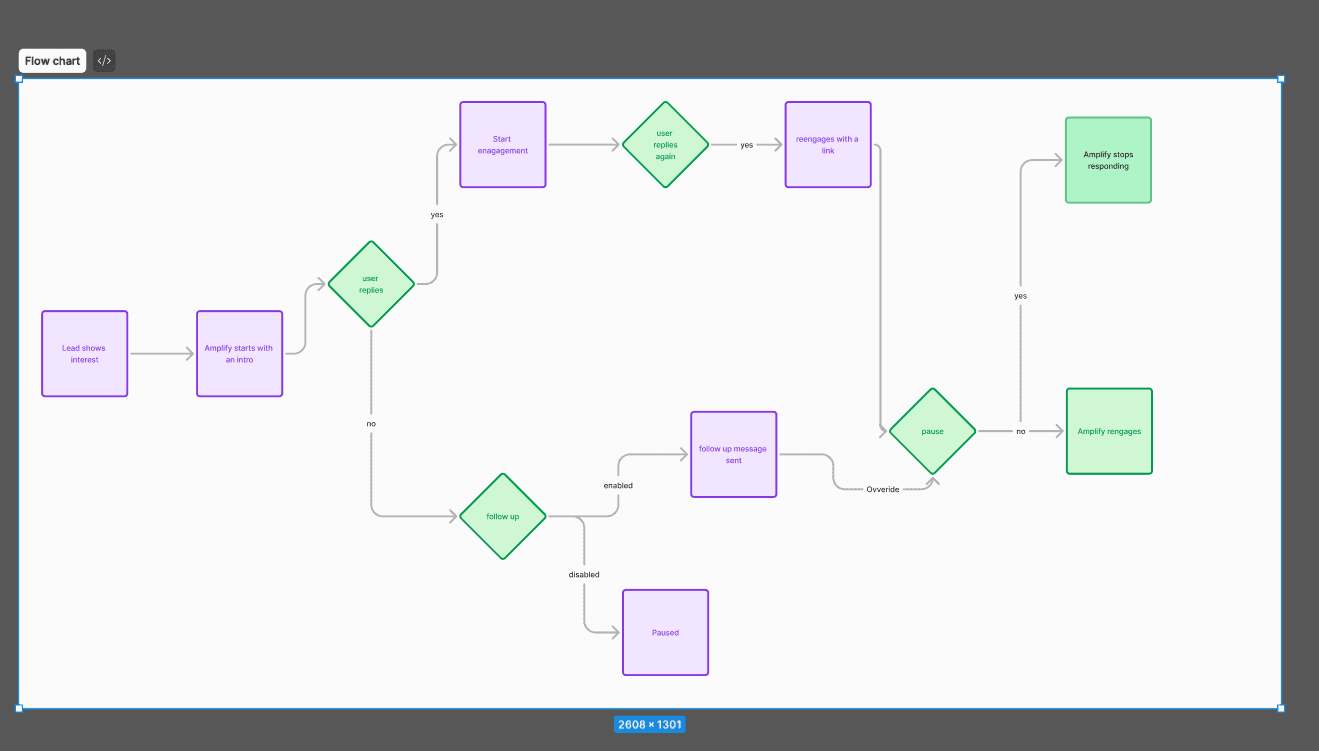
I mapped follow-up behavior across agent type, lead situation, timing, time zone, message frequency, and conversation state. This turned the project from adding a reminder into designing a controlled automation system.
Decisions and tradeoffs
Use rules for timing and AI for writing
Decision:
I separated the parts that needed predictable rules from the part AI handled. The system decided whether and when to send a follow-up. The AI wrote the message within those limits.
Tradeoffs:
Building clear scheduling rules took more engineering effort, but gave studios predictable behavior and made failures easier to test.
Constraints:
The AI could not safely decide timing on its own. Sending too often or at the wrong time could annoy leads or cause the messaging provider to block campaigns.
Result:
Follow-ups felt automated without allowing the AI to make risky decisions about when customers should be contacted.
Give the AI enough context to write a useful message
Decision:
I gave the AI the agent’s goal, conversation state, studio information, and examples for common situations before it generated a follow-up.
Tradeoffs:
Studios had to provide some examples during setup, but the AI produced more relevant messages instead of guessing why a lead stopped responding.
Constraints:
A silent lead gives no clear reason for leaving. The studio knowledge base could answer factual questions, but it was not designed to explain the right follow-up for each situation.
Result:
The AI could continue the conversation with a message that matched the lead’s situation instead of sending the same reminder to everyone.
Make setup simple without losing control or safety
Decision:
I provided recommended timing, frequency, sample messages, quiet hours, and automatic time-zone handling. Owners could start quickly and adjust the settings that mattered.
Tradeoffs:
Defaults made setup faster, but messages could sound generic if owners never reviewed them. More customization improved relevance but made the feature harder to configure.
Constraints:
Owners could not override every safety limit. Very frequent or poorly timed messages could harm customer trust and affect message delivery for the studio.
Result:
Studio owners could activate follow-ups quickly, understand how they worked, and rely on guardrails to prevent excessive or poorly timed outreach.
Outcome
4× higher lead conversion
Conversations without follow-ups converted at about 7%. Conversations with one Amplify follow-up converted at about 28%.
131 additional trial signups
Automated follow-ups recovered opportunities that would otherwise have ended after the first unanswered message.
Fewer conversations ended after first contact
Amplify continued engagement when a lead became silent instead of requiring staff intervention.
No manual follow-up workload for studios
Scheduling, time zones, quiet hours, and message generation ran automatically within defined safeguards.
Solution
The final system allowed each AI agent to follow up based on the service it was selling.
Studio owners could control timing and frequency within safe limits, while quiet hours, time-zone handling, provider limits, and system guardrails protected customers and deliverability. Situation-based examples gave the model enough context to generate a relevant follow-up without asking it to infer why a lead became silent.
The experience connected configuration, automated scheduling, AI message generation, and conversation tracking without requiring studio staff to chase leads manually.
Behind the scenes
End-to-end ownership: I moved from behavioral analysis and customer feedback into system strategy, AI behavior, workflow design, interaction details, validation, implementation support, and post-launch iteration.
Product and AI collaboration: I worked with the Product Owner to define what automation should and should not do, and partnered with the LLM Engineer to separate deterministic system behavior from model-generated content.
Engineering collaboration: I reviewed scheduling, time zones, quiet hours, provider limits, and failure states with backend engineers. With frontend engineers, I refined controls, defaults, and explanations so owners could understand automation without documentation.
Delivery and learning: I documented states and edge cases for QA, adjusted behavior through internal reviews, and used conversion and configuration data after launch to identify the next message-quality problem.
Work